
Planted as a pecan orchard around 1919
Concrete Contractors in Groves, TX
Big trees, low ground and 1950s homes: concrete in Groves has to work around all three.
- Free estimate at your property, with every line of the price written out
- Slope, base and runoff worked out for Beaumont's 65-inch rain years
- City permit and 311 inspection steps confirmed for your address first
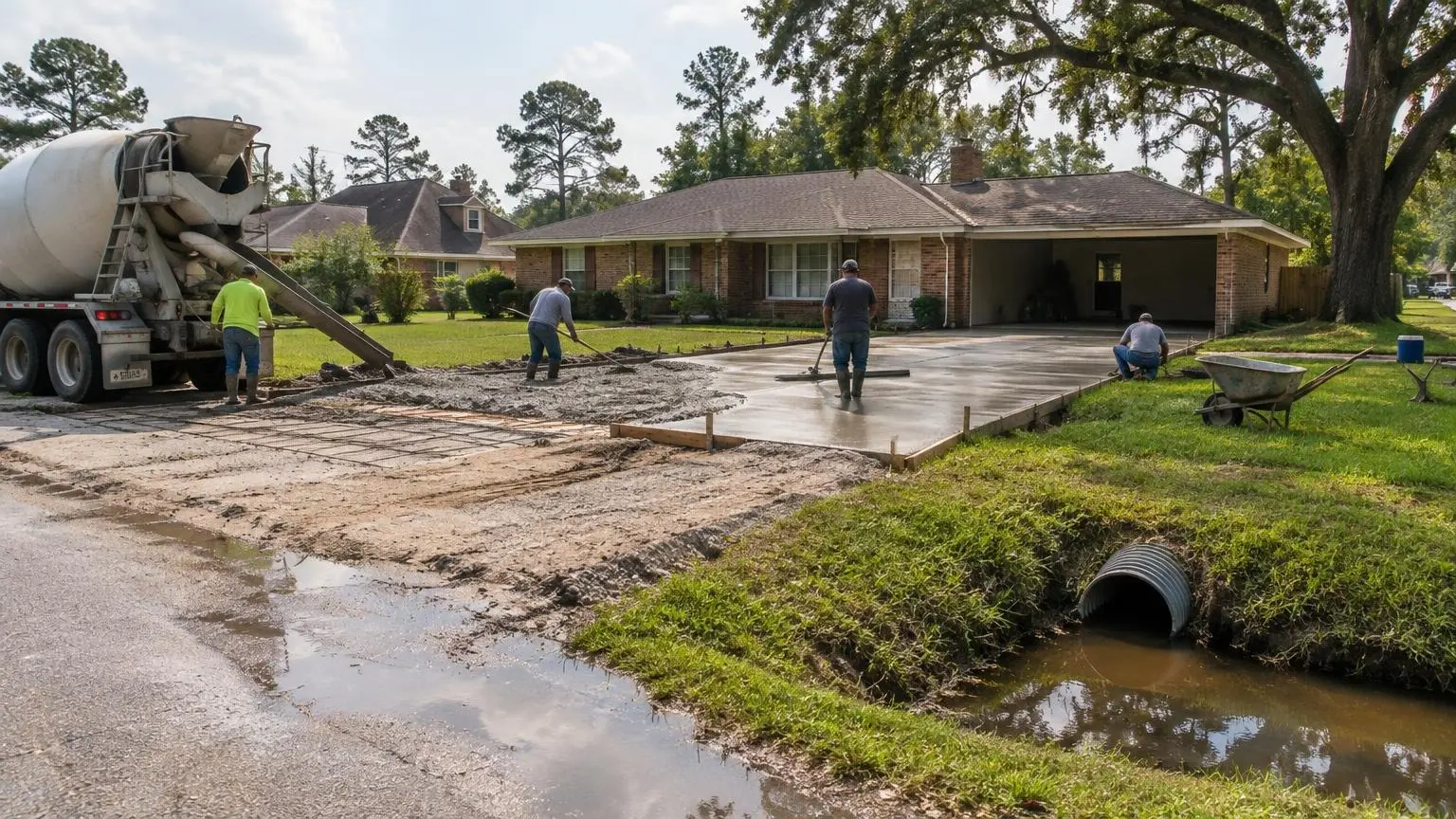
Concrete in a Town Named for Its Trees
Groves started as an orchard, and concrete contractors working here still deal with what that means. Around 1919, several thousand pecan trees were planted on a 385-acre tract, and the land was sold as a residential subdivision called Pecan Grove. The name was later shortened to Groves. A century on, mature trees shade many lots, and their roots run under driveways, walks and patios all over town.
Trees and concrete, side by side
Large trees and concrete can share a yard, but a few rules help:
- Give trunks room. Pouring right up to a trunk invites a crack as the tree grows.
- Reinforce near roots. Rebar or mesh will not stop a root, but it keeps a cracked panel from splitting into loose pieces.
- Thicken where needed. A slightly thicker section over a root zone spreads the load.
- Plan joints. Control joints placed near the tree let the slab crack where we choose.
When roots have already pushed up a walk or driveway panel, we remove the lifted sections and look at the roots before re-pouring. Large structural roots should not be cut without advice from an arborist, and we will say so before anything is removed.
Low ground near Sabine Lake
Most of Groves sits 5 to 15 feet above sea level, and Sabine Lake is about 3 miles southeast. Port Arthur surrounds the city on three sides. On land this low, water is the second big factor after trees. A driveway or patio needs a steady fall away from the house, and the ground at the edges needs to be graded so water does not run back under the slab. We set string lines and check slope before every pour so water ends up in the street or yard drain, not against your foundation.
Homes from the 1950s and 1960s
Groves incorporated in 1952 after two failed votes. The Texas State Historical Association estimates about 1,300 residents in the early 1950s and lists 17,304 by 1960, so most of the town was built in roughly a decade. The Atlantic refinery had opened in town in 1936, and Groves became a heavily industrial place. That makes a lot of the original flatwork 60 to 70 years old.
Common problems on lots of that age:
- Driveways with a large crack running down the middle and panels that no longer line up
- Garage floors that are fine inside but broken at the apron
- Narrow walks that were never replaced and now sit below the lawn
- Patios added later by owners, without base prep or joints
What we pour in Groves
Driveways: full replacements, widened drives and new aprons. Sidewalks and walkways: front walks, side gates to the backyard and steps at the porch. Patios: broom-finished or stamped, sized for the yard and shaped around existing trees. Stamped concrete: for entries and patios where you want stone or brick looks without loose pieces for roots to shift. Slabs: pads for sheds, workshops and equipment. Repair: crack sealing, sectional replacement and lifting of trip edges by removing and re-pouring.
Small city, close neighbors
Groves covers just over 5 square miles, with 7,078 housing units in 2020 and a homeowner vacancy rate of only 1.5%. Lots are close together, so access matters. We plan where the truck and pump will go, protect lawns and neighboring drives, and keep the job site tidy. Before work that touches the street or public sidewalk, we check what the city requires.
Pecan roots and the garage apron
The pecan trees that gave Groves its name are large, long-lived and shallow-rooted, and the spot where a driveway meets the garage is often where trouble shows. That apron sits on backfill dug out for the house foundation, and roots that reach it lift one side while the backfill settles on the other. When we replace an apron, we cut it free with a saw, dig out the soft fill, compact new base in layers and dowel the new section into the garage slab and the drive so all three stay at one height.
Groves Facts for Homeowners
- A pecan grove origin. Around 1919, several thousand pecan trees were planted on a 385-acre tract that was sold as the Pecan Grove subdivision, later Groves.
- Low elevation. Most of the city lies 5 to 15 feet above sea level, about 3 miles northwest of Sabine Lake.
- 1950s growth. Groves had an estimated 1,300 residents in the early 1950s and 17,304 by 1960, after incorporating in 1952.
- Tight housing market. The 2020 census counted 7,078 housing units on about 5.2 square miles, with a 1.5% homeowner vacancy rate.
Our Services in Groves, TX
Groves Questions
Will a new driveway in Groves just get lifted by my pecan tree again?
It can if the tree is close and growing. We reduce the risk with reinforcement, a thicker section over the root zone and joints near the tree. In some cases we suggest shifting the drive edge away from the trunk.
Can you pour a patio around an existing tree?
Yes. We leave an opening around the trunk sized for growth and avoid heavy digging close to it. The opening can be filled with mulch or gravel.
My Groves garage apron has dropped. Do I need a new driveway?
Not always. If the rest of the drive is sound, we can remove just the apron, rebuild the base and pour a new section doweled into the slab.
Free Estimates in Groves, TX
Free estimates on Groves driveways, walks and patios.
Concrete Contractors Near Groves
- Concrete Contractors in Beaumont, TX
- Concrete Contractors in Port Arthur, TX
- Concrete Contractors in Nederland, TX
- Concrete Contractors in Port Neches, TX
- Concrete Contractors in Vidor, TX
- Concrete Contractors in Lumberton, TX
- Concrete Contractors in Orange, TX
- Concrete Contractors in Bridge City, TX
- Concrete Contractors in Silsbee, TX
- Concrete Contractors in Sour Lake, TX
- Concrete Contractors in Kountze, TX
- Concrete Contractors in Pinehurst, TX
- Concrete Contractors in West Orange, TX
- Concrete Contractors in Central Gardens, TX
- Concrete Contractors in Fannett, TX
- Concrete Contractors in Bevil Oaks, TX
- Concrete Contractors in Mauriceville, TX
- Concrete Contractors in China, TX
- Concrete Contractors in Pinewood Estates, TX
- Concrete Contractors in Hamshire, TX