
More than 65 inches of rain a year, the most in Texas
Concrete Contractors in Beaumont, TX
Driveways, patios, slabs and repairs planned for a flat city 16 feet above sea level where water has to go somewhere.
- Free estimate at your property, with every line of the price written out
- Slope, base and runoff worked out for Beaumont's 65-inch rain years
- City permit and 311 inspection steps confirmed for your address first
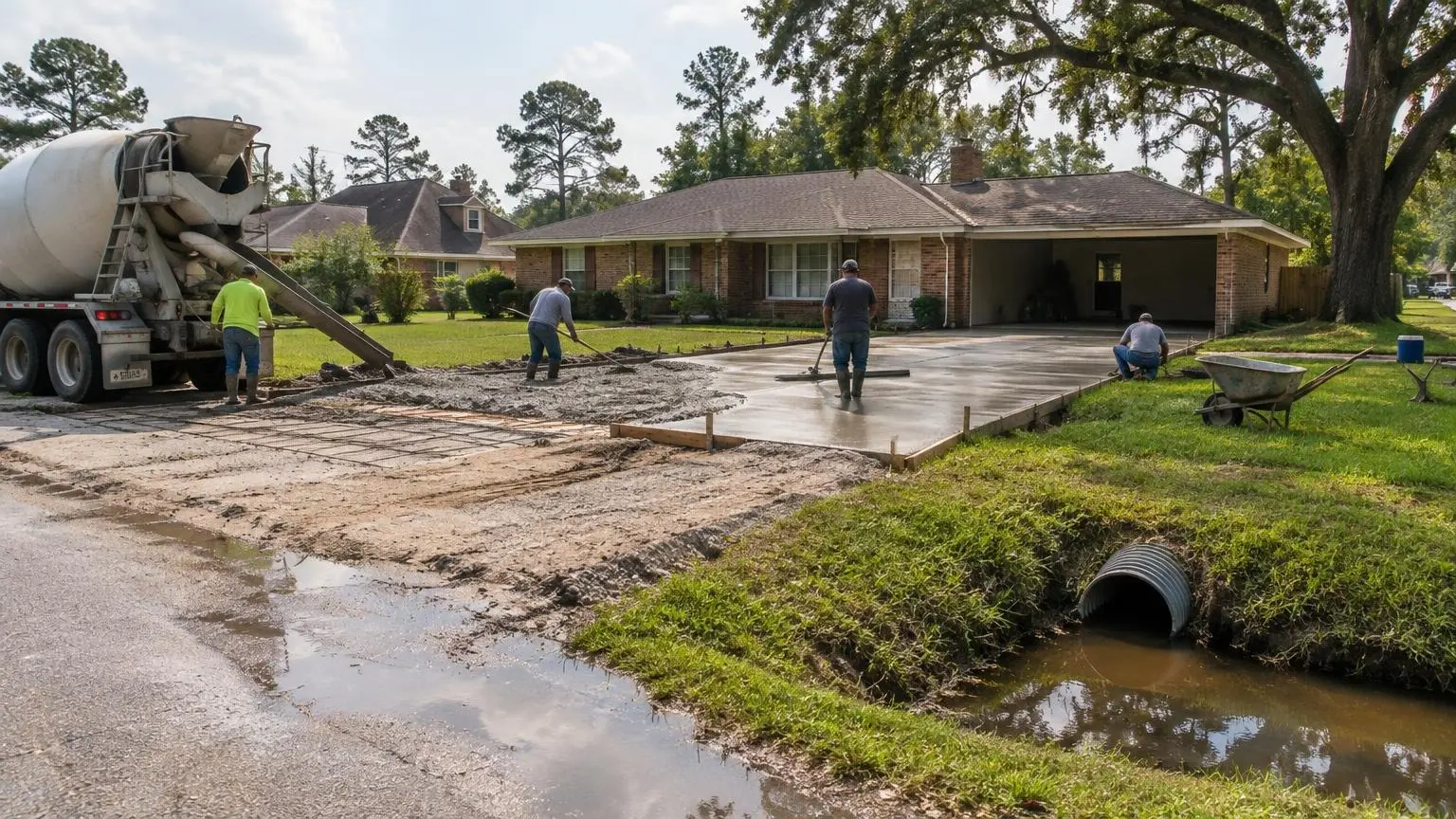
Concrete Work Built for Beaumont Ground and Beaumont Rain
Beaumont is our home city, and as concrete contractors here we plan every pour around two facts: the ground is flat and the rain is heavy. Wikipedia puts the city at 16 feet above sea level on the Texas coastal plain, about 30 miles inland from the Gulf, and lists average rainfall at 65.07 inches a year. The Neches River runs along the east side and Pine Island Bayou along the north. That combination shapes how we grade a driveway, how we slope a patio and how we build a slab that stays put.
What the city asks for on driveways
The City of Beaumont publishes its driveway rules through the Public Works Engineering Division, and they are worth knowing before anyone mixes a yard of concrete. Any construction in the public right-of-way, which includes the apron that meets the street and the sidewalk crossing, needs a permit. The city's standard calls for:
- 4 inches of concrete for a residential drive, 6 inches for commercial
- 3,000 psi concrete at 28 days
- No. 6 wire mesh or No. 4 rebar at 12 inches on center
- A base compacted to 95% of standard Proctor
- A maximum slope of 12% and a 2% cross slope where the drive lines up with a sidewalk
- A residential width of at least 10 feet and no more than 35 feet
Inspections are booked through 311. The city wants to see the forms and reinforcement before the pour, then again when the work is finished. We set the forms, place the steel and schedule that pre-pour visit so nothing gets poured over an unchecked base. On private property, work that disturbs more than 450 square feet needs a grading permit, and smaller hard surfaces must still sit at least 2 feet off interior property lines.
A city with a lot of 1960s and 1970s concrete
Census housing data summarized by Point2Homes puts the median home in Beaumont at 1978, with 17.2% of homes built in the 1960s and 18.6% in the 1970s. The city's population jumped from 94,014 in 1950 to 119,175 in 1960, so whole neighborhoods went in fast. Concrete from that era is now 50 to 60 years old. Common things we look at on those properties:
- Driveways with cracked panels and low corners where water has washed out the base
- Front walks that tip toward the house instead of away from it
- Patio slabs poured without control joints that cracked on their own lines
- Garage aprons that dropped below the slab and now catch every rain
Clay underfoot and water on top
The ground under much of the region is the Beaumont Formation, a Pleistocene deposit named for the city whose main material is clay. Clay holds water, softens when wet and pulls back when it dries. On a site like this, the base under the concrete matters more than the concrete itself. We cut out soft or organic soil, bring in select fill or crushed stone, compact it in lifts and keep the finished surface sloped so water runs off rather than pooling at the edge. A slab that sheds water stays drier underneath, and drier clay moves less.
The six things we do
Concrete driveways. New drives, widened drives and full tear-outs, formed to the city spec and inspected where the right-of-way is involved.
Concrete patios. Backyard slabs sloped away from the house, with joints placed where the slab wants to crack anyway.
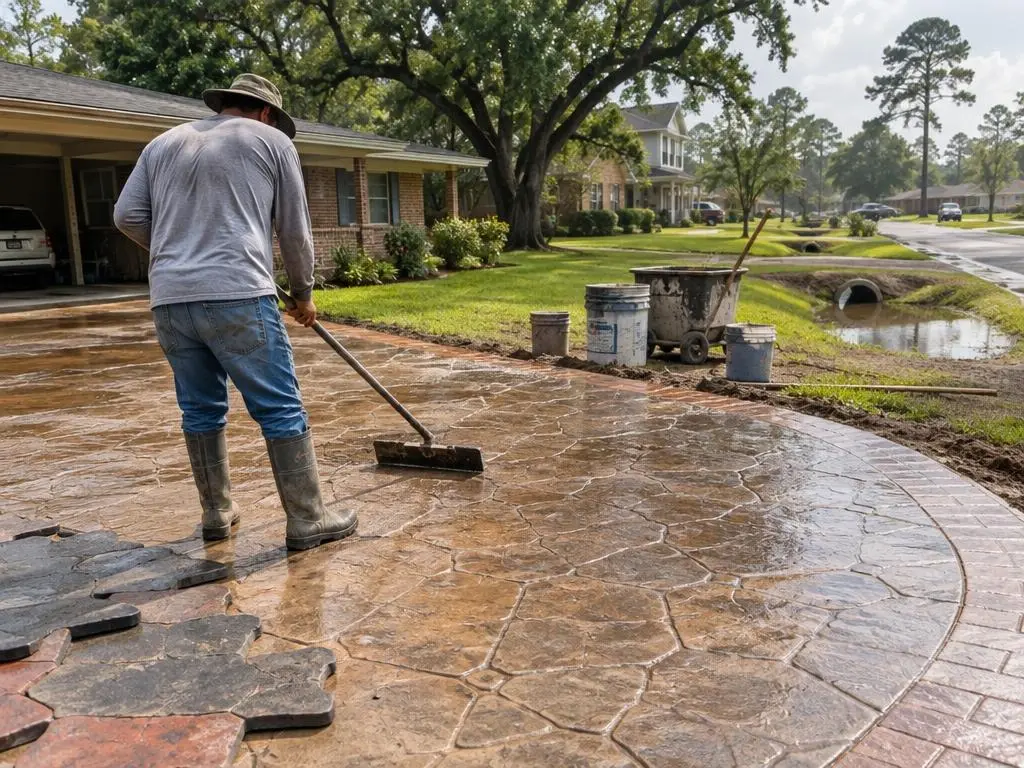
Stamped concrete. Patterned and colored patios, walks and drive borders. In a hot, wet climate we seal stamped work so color holds and the surface resists mildew.
Sidewalks and walkways. Front walks, side yard paths and the public sidewalk panel in front of your house, which falls under the same right-of-way permit.
Concrete slabs. Shop floors, carports, shed pads, AC pads and slab additions with a vapor barrier and thickened edges where loads need it.
Concrete repair. Sectional replacement of broken panels, crack routing and sealing, and resurfacing where the base is still sound.
Weather and scheduling
Beaumont's July average high is 92 degrees, and the wet season runs April through October. Hot afternoons dry fresh concrete too fast, so summer pours here start early in the morning. We watch the radar in the wet months, keep plastic on hand to protect a fresh surface from a pop-up storm and cure the concrete with water or a curing compound so it gains strength slowly. Hard freezes are rare, but the city has a record low of 10 degrees, so we still avoid pouring right before a cold snap.
From the Oaks to the west end
The Oaks Historic District holds some of the oldest houses in the city, including the McFaddin-Ward House from 1905 to 1906. Older lots like these often have narrow drives, mature trees and walks laid long before modern codes. Newer subdivisions have wider lots and builder-grade flatwork that may need sealing, joint repair or a wider drive. We walk the property first, tell you what we see and write the scope down before any work is scheduled.
Beaumont Facts That Affect Concrete
- Heavy rainfall. Beaumont averages 65.07 inches of rain a year, the most of any area in Texas, with a wet season from April to October.
- Flat, low ground. The city sits at 16 feet above sea level on the coastal plain, bordered by the Neches River on the east and Pine Island Bayou on the north.
- City driveway standard. Public Works calls for 4-inch residential drives, 3,000 psi concrete, No. 6 mesh or No. 4 rebar at 12 inches, and pre-pour and final inspections through 311.
- Housing age. The median home was built in 1978, and about 36% of homes date from the 1960s and 1970s.
- Clay formation. The Beaumont Formation, named for the city, is a Pleistocene deposit made up mainly of clay.
Our Services in Beaumont, TX
Beaumont Questions
Do I need a permit to replace my driveway in Beaumont?
If any part of the work is in the public right-of-way, such as the apron at the street or the sidewalk crossing, the City of Beaumont requires a permit through Public Works. Work on private property that disturbs more than 450 square feet also needs a grading permit. We help you sort out which applies and schedule the pre-pour and final inspections.
How thick should a driveway be in Beaumont?
The city's residential standard is 4 inches of 3,000 psi concrete with No. 6 wire mesh or No. 4 rebar at 12 inches on center. Where heavier trucks or trailers park, we talk with you about going thicker and adding steel.
Why does my old Beaumont driveway have sunken corners?
Usually water has worked under the edges and carried base material away, or the soil below was soft to begin with. We cut out the failed sections, rebuild and compact the base, and pour new panels tied to the old ones with dowels where it makes sense.
Free Estimates in Beaumont, TX
Free estimates anywhere in Beaumont, from the Oaks to the west side.
Concrete Contractors Near Beaumont
- Concrete Contractors in Port Arthur, TX
- Concrete Contractors in Nederland, TX
- Concrete Contractors in Port Neches, TX
- Concrete Contractors in Groves, TX
- Concrete Contractors in Vidor, TX
- Concrete Contractors in Lumberton, TX
- Concrete Contractors in Orange, TX
- Concrete Contractors in Bridge City, TX
- Concrete Contractors in Silsbee, TX
- Concrete Contractors in Sour Lake, TX
- Concrete Contractors in Kountze, TX
- Concrete Contractors in Pinehurst, TX
- Concrete Contractors in West Orange, TX
- Concrete Contractors in Central Gardens, TX
- Concrete Contractors in Fannett, TX
- Concrete Contractors in Bevil Oaks, TX
- Concrete Contractors in Mauriceville, TX
- Concrete Contractors in China, TX
- Concrete Contractors in Pinewood Estates, TX
- Concrete Contractors in Hamshire, TX